Introduction
Specialist Supplements Ltd. has been trading since 1994, and has been at the forefront of the UK food and dietary supplements industry, consistently upholding the highest standards of quality, compliance, and ethical practice. Our extensive experience has provided us with deep insights into the intricate regulatory landscape governing this sector, including the often-complex Value Added Tax (VAT) rules. This comprehensive guide aims to demystify the VAT implications for businesses involved in the sale of food supplements within the United Kingdom, drawing upon our expertise and adherence to critical regulations such as those from the Food Standards Agency (FSA), Good Manufacturing Practice (GMP), and ISO standards.
Understanding VAT is crucial for any business operating in the food supplement market. Misinterpretation can lead to significant financial penalties and operational disruptions. While many food products in the UK are zero-rated for VAT, food supplements often fall into a different category, typically subject to the standard rate. This distinction is not always straightforward and has been the subject of numerous tribunal cases, highlighting the need for clear guidance.
The Fundamentals of VAT on Food Products in the UK
In the UK, the general principle is that most food and drink for human consumption is zero-rated for VAT. However, this principle is subject to numerous exceptions. HMRC defines 'food' for VAT purposes based on whether an average person would consider it food or drink and if it is fit for human consumption. Crucially, certain items, despite being edible, are specifically excluded from zero-rating and are standard-rated at 20%. These exceptions often include confectionery, dietary supplements, food additives, and similar products.
Food Supplements: A Closer Look at VAT Liability
The core issue for food supplements lies in their classification. HMRC's internal manuals, such as VFOOD1960, explicitly state that vitamins and trace elements, while essential for human nutritional requirements, are not considered 'food' for VAT purposes. Consequently, vitamin and mineral supplements, whether in pill, capsule, powder, or liquid form, are generally standard-rated. The addition of vitamins and/or minerals to an otherwise normal food product does not typically alter the VAT liability of the product as a whole.
Recent Tribunal Cases
Recent tribunal cases further illustrate the complexities. For instance, the case involving 'Skinade,' a liquid collagen supplement, highlighted that the marketing, packaging, and primary purpose of a product significantly influence its VAT classification. Despite containing ingredients that might be zero-rated individually, the First-tier Tax Tribunal (FTT) ruled that Skinade was a beauty product, not food, and therefore subject to standard-rate VAT. This decision underscores that the VAT position is determined by the finished product's overall nature and intended use, rather than solely its constituent ingredients.
Conversely, some powdered vegan food supplements have been successfully argued to be zero-rated, demonstrating that each product's specific characteristics and presentation are critical. Businesses must carefully assess their products against HMRC's guidelines and precedents to determine the correct VAT treatment.
Regulatory Framework: FSA, GMP, and ISO Standards
Beyond VAT, the sale of food supplements in the UK is governed by a robust regulatory framework designed to ensure product safety, quality, and accurate information for consumers. Specialist Supplements Ltd. adheres strictly to these guidelines, reflecting our commitment to excellence and consumer trust.
Food Standards Agency (FSA) Regulations
The FSA is responsible for food safety and hygiene in the UK. Food supplements are regulated as food and are subject to the provisions of general food law. This means products must be safe for consumption and not misleadingly labelled. Key aspects include:
- Definition: A food supplement is defined as 'any food the purpose of which is to supplement the normal diet and which is a concentrated source of a vitamin or mineral or other substance with a nutritional or physiological effect, alone or in combination and is sold in dose form.'
- Labelling: Food supplements must comply with general food labelling requirements, including product name, ingredients, allergens, daily dose, and mandatory warnings. Claims to treat or prevent any disease or adverse medical condition are not permitted.
- Registration: While there is no requirement for food supplements to be licensed or registered with the UK Government, food business operators must register their business with the Environmental Health or Trading Standards service at their local authority.
Good Manufacturing Practice (GMP)
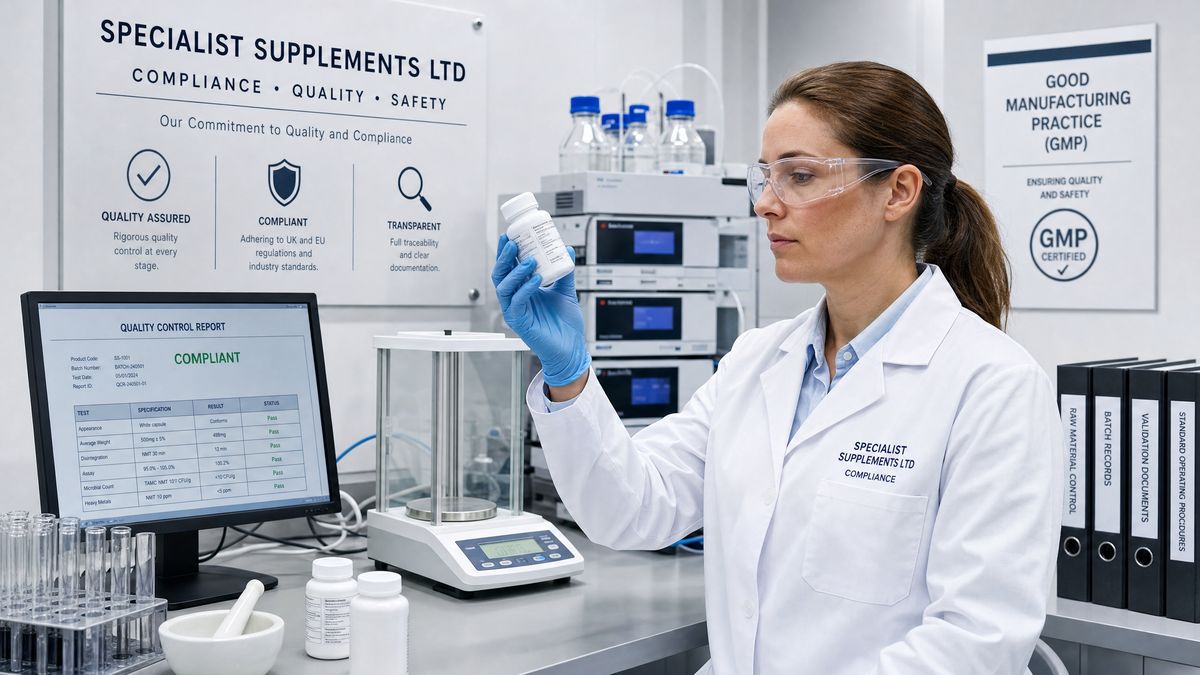
GMP is a system for ensuring that products are consistently produced and controlled according to quality standards. It is designed to minimize the risks involved in any pharmaceutical production that cannot be eliminated through testing the final product. For food supplements, GMP ensures:
- Quality Control: Products are manufactured in a controlled environment, adhering to strict quality control procedures at every stage, from raw material sourcing to final product release.
- Consistency: Each batch of product is consistent in quality, purity, and potency.
- Documentation: Comprehensive documentation of all manufacturing processes, quality checks, and personnel training is maintained.
Our commitment to GMP is a cornerstone of our operations, guaranteeing that every product leaving our facilities meets the highest possible standards.
ISO Standards
International Organization for Standardization (ISO) standards provide a framework for quality management and food safety. ISO 22000, for example, specifies requirements for a food safety management system (FSMS) that combines the following generally recognized key elements to ensure food safety along the food chain:
- Interactive communication: Ensuring effective communication throughout the food chain.
- System management: Managing the FSMS within a structured management system.
- Prerequisite programmes (PRPs): Establishing and maintaining hygienic conditions.
- HACCP principles: Implementing Hazard Analysis and Critical Control Points to identify and control food safety hazards.
Adherence to ISO standards demonstrates a commitment to international best practices in food safety and quality management, further reinforcing the reliability and integrity of our products.
Conclusion and Call to Action
The landscape of VAT and regulation for food supplements in the UK is complex, requiring diligent attention to detail and a thorough understanding of current legislation. Specialist Supplements Ltd. leverages its experience trading since 1994 and unwavering commitment to FSA, GMP, and ISO standards to navigate these complexities, ensuring our partners receive compliant, high-quality products.
We understand that for trade customers, competitive pricing is paramount. To protect the commercial interests of our partners, our pricing information is not publicly displayed. We invite all prospective trade clients to join our growing network of successful businesses.
Register for a trade account today to access exclusive pricing and our full range of premium, compliant food supplements:
Register for a Trade Account