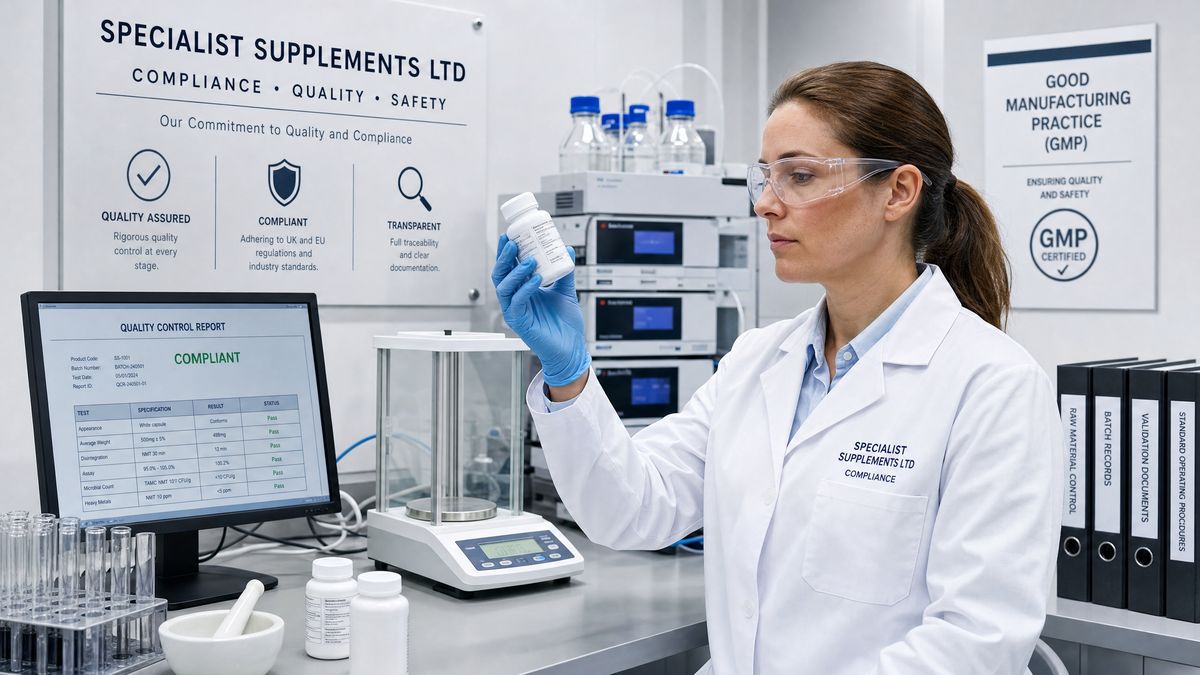
GMP Certified
ISO 9001 Certified
FSA Compliant
Navigating the Regulatory Framework: The Food Standards Agency (FSA)
The Food Standards Agency (FSA) serves as the primary governmental body responsible for food safety and hygiene across England, Wales, and Northern Ireland. Its role is critical in safeguarding public health and ensuring that food businesses, including those dealing with food supplements, adhere to stringent standards. Under UK law, a food supplement is precisely defined as "any food the purpose of which is to supplement the normal diet and which is a concentrated source of a vitamin or mineral or other substance with a nutritional or physiological effect, alone or in combination and is sold in dose form" [1]. This definition encompasses a wide array of products, from vitamins and minerals to amino acids, essential fatty acids, fibre, and various plant and herbal extracts [1].
For businesses, compliance with FSA regulations is not optional but a legal imperative. While food supplements do not typically require pre-market approval in the UK, businesses must notify local authorities in the area of their operation [2]. Key FSA guidelines cover aspects such as general food labelling requirements, ensuring that consumers receive accurate and transparent information about the products they purchase [1]. It is crucial for brands to understand the clear distinction between food supplements and medicinal products; supplements are intended to complement the diet and cannot claim to treat, prevent, or cure diseases, as they do not exert a pharmacological, immunological, or metabolic action [1]. Adherence to these regulations ensures market entry and fosters consumer confidence in the safety and efficacy of the products.
Good Manufacturing Practice (GMP): The Unwavering Standard for Quality Production
Good Manufacturing Practice (GMP) represents a system of processes and procedures designed to ensure that products are consistently produced and controlled according to quality standards. Its global significance cannot be overstated, as it provides a framework for manufacturers to minimize risks inherent in any pharmaceutical or food production that cannot be eliminated through testing the final product alone [3]. For premium supplement brands in the UK, GMP certification is not merely a badge of honour but a fundamental assurance of product consistency, safety, and quality.
Quality Management Systems
Establishing a robust system to manage quality throughout the production lifecycle.
Facilities and Equipment
Ensuring that manufacturing facilities are designed, maintained, and operated to prevent contamination and errors, and that equipment is properly calibrated and validated.
Personnel
Employing qualified and trained personnel who understand their roles and responsibilities in maintaining quality standards.
Production
Implementing clear, documented procedures for all production steps to ensure consistency and prevent deviations.
Quality Control
Establishing comprehensive testing and control measures for raw materials, in-process materials, and finished products to verify their identity, purity, strength, and composition [3].
While GMP standards for food supplements share common objectives with those for medicines—primarily ensuring product safety and quality—there can be nuanced differences in their specific application and regulatory oversight. In the UK, food supplements are regulated as food, and thus, GMP for food supplements aligns with general food law provisions [4]. Reputable third-party bodies conduct independent audits to certify manufacturers against these rigorous GMP standards, providing an external validation of a brand's commitment to excellence [5].
ISO Standards: Elevating Global Food Safety and Quality Management
ISO 22000: Food Safety Management Systems
ISO 22000 is a globally recognized standard that specifies requirements for a food safety management system (FSMS). Its comprehensive scope extends across the entire food supply chain, from primary production to consumption, making it highly relevant for supplement manufacturers, distributors, and retailers [6]. A key strength of ISO 22000 is its integration of the core principles of Hazard Analysis and Critical Control Points (HACCP), a systematic preventive approach to food safety from biological, chemical, and physical hazards in production processes [6].
Why ISO 22000 is Vital for Premium Supplement Brands:
- Retail Acceptance: Major retailers, health stores, and online marketplaces (such as Amazon UK) often require suppliers to meet robust food safety standards, with ISO 22000 providing the necessary documentation and traceability [6].
- Streamlined Audits: Certification can lead to fewer interruptions and faster onboarding with major distributors, as it provides external validation of a manufacturer's commitment to safety [6].
- International Market Access: As a global benchmark, ISO 22000 facilitates navigation of cross-border regulations, enabling faster expansion into international markets by enhancing credibility with customs and regulators [6].
ISO 9001: Quality Management Systems
ISO 9001 is an international standard for quality management systems (QMS) that focuses on ensuring an organization consistently provides products and services that meet customer and regulatory requirements. While ISO 9001 emphasizes consistency in manufacturing processes, it is important to note that it does not inherently guarantee the quality of the end product itself [5]. A manufacturer could consistently produce a product of poor quality and still be ISO 9001 certified, as long as their processes are consistently followed [5].
Despite this distinction, ISO 9001 plays a foundational role in quality assurance. For supplement brands, it signifies a commitment to robust internal processes, continuous improvement, and customer satisfaction. It complements food safety-specific certifications like ISO 22000 by ensuring that the overall management system supports the production of high-quality products.
Other Relevant ISO Standards
While ISO 22000 and ISO 9001 are most directly applicable to product safety and quality, other ISO standards may be relevant depending on a brand's specific operations and values. For instance, ISO 14001 focuses on environmental management systems, demonstrating a company's commitment to minimizing its environmental footprint. While important for corporate social responsibility, it does not directly address product quality or safety standards [5].
The Competitive Edge: Why Certifications Are Indispensable for Premium Brands
Building Unwavering Consumer Trust
Certifications provide independent verification of a brand's claims regarding quality, safety, and ethical production, fostering deep trust with discerning consumers.
Meeting and Exceeding Retailer Expectations
As evidenced by platforms like Amazon UK and major UK retailers, specific accreditations are often prerequisites for listing and distribution, ensuring market access and growth opportunities [5] [6].
Facilitating Global Expansion
For brands with international aspirations, globally recognized certifications like ISO 22000 act as a passport, simplifying regulatory navigation and enhancing credibility in diverse markets [6].
Mitigating Risks and Ensuring Legal Compliance
Adhering to certified standards significantly reduces the risk of product recalls, legal challenges, and reputational damage, safeguarding the brand's long-term viability.
Demonstrating a Commitment to Excellence
Beyond regulatory minimums, these certifications showcase a brand's proactive dedication to best practices, continuous improvement, and an uncompromising pursuit of excellence in every aspect of its operations.
Navigating the Certification Journey
The path to certification involves a structured process that typically includes initial assessments, implementation of required systems, documentation, internal audits, and external audits by accredited bodies. It is an ongoing commitment, requiring continuous monitoring, review, and improvement to maintain certification status. Choosing the right certification partners—those with deep industry expertise and a proven track record—is crucial for a smooth and successful journey.
Ready to Elevate Your Brand?
Partner with Specialist Supplements Ltd. to ensure your products meet the highest standards of quality and compliance.
Contact Us Today