Understanding UK Food Supplement Regulations
What is a Food Supplement?
The Food Standards Agency (FSA) defines a food supplement as \'any food the purpose of which is to supplement the normal diet and which is a concentrated source of a vitamin or mineral or other substance with a nutritional or physiological effect, alone or in combination and is sold in dose form\' [1]. These products are designed to supplement the normal diet and are not intended to treat, prevent, or cure diseases, nor to modify physiological functions in a medicinal capacity.
Key Regulatory Bodies
Food Standards Agency (FSA)
Responsible for food safety and hygiene across England, Wales, and Northern Ireland.
Department of Health and Social Care (DHSC)
Sets policy for food supplements in England.
Food Standards Scotland
Oversees food safety and standards in Scotland.
Welsh Government
Responsible for food supplement policy in Wales.
The Legal Framework
The Food Supplements (England) Regulations 2003
Along with equivalent regulations for Scotland (2003), Wales (2003), and Northern Ireland (2003), these regulations specify compositional and labelling requirements for food supplements, including permitted vitamins and minerals [1].
Regulation (EU) No 1169/2011 on the provision of food information to consumers (FIC)
This retained EU law sets out general food labelling requirements that all food supplements must comply with in Great Britain [1].
Registering Your Business and Operational Requirements
Becoming a Food Business Operator (FBO)
Anyone selling food supplements in the UK, including online, must register as a Food Business Operator (FBO) with their local authority. This is a fundamental step to ensure accountability and compliance with food safety standards [1]. Registration typically involves informing your local council of your business activities.
Sourcing and Traceability
Using Reputable Suppliers
Businesses should source products from suppliers who prioritize quality, compliance, offer low Minimum Order Quantities (MOQs), and are ideally UK-based. Specialist Supplements Ltd embodies these criteria, ensuring legitimate, high-quality products and comprehensive documentation, such as fully referenced invoices and receipts [1]. This approach helps in verifying the legitimacy and quality of the products.
Record Keeping
Maintaining meticulous records of where food supplements were sourced from and to whom they were sold is crucial for traceability. These records, including invoices and delivery notes, must be made available to enforcement authorities upon request [1]. This ensures that in the event of a product recall or safety concern, affected batches can be quickly identified and managed.
Product Composition and Labelling Standards
Accurate and compliant labelling is paramount for food supplements, providing consumers with essential information and ensuring product safety. Misleading or incorrect labelling can lead to severe penalties.
Permitted Ingredients
Vitamins
Minerals
Amino acids
Essential fatty acids
Fibre
Various plant and herbal extracts [1]
Only vitamins, minerals, and nutrients included on permitted lists are allowed in food supplements, and businesses should regularly review these lists to ensure compliance [2].
\'Food Supplement\' vs. \'Dietary Supplement\'
It is a specific legal requirement in the UK that products must be labelled as \'food supplement\' and not \'dietary supplement\' [1]. This distinction is important for regulatory clarity and consumer understanding.
Mandatory Label Information
Business Name and Address
The name and address of the business responsible for the food information, which can be the marketer or the importer.
Ingredients List
A comprehensive list of all ingredients, with common allergens clearly emphasised.
Conditions for Use
This includes the recommended daily dosage and a clear warning not to exceed it.
Storage Instructions
Guidance on how to store the product, including a statement that it should be kept out of the reach of young children.
Date Marking
A \'use by\' or \'best before\' date to indicate shelf life.
Nutrient Content
The amount of any vitamin, mineral, or other substance with a nutritional or physiological effect present in the product.
Disclaimer
A statement that food supplements should not be used as a substitute for a varied diet.
This information must be clearly visible on the packaging, a label attached to the packaging, or a label visible through the packaging [1].
Quality Assurance: GMP and ISO Standards
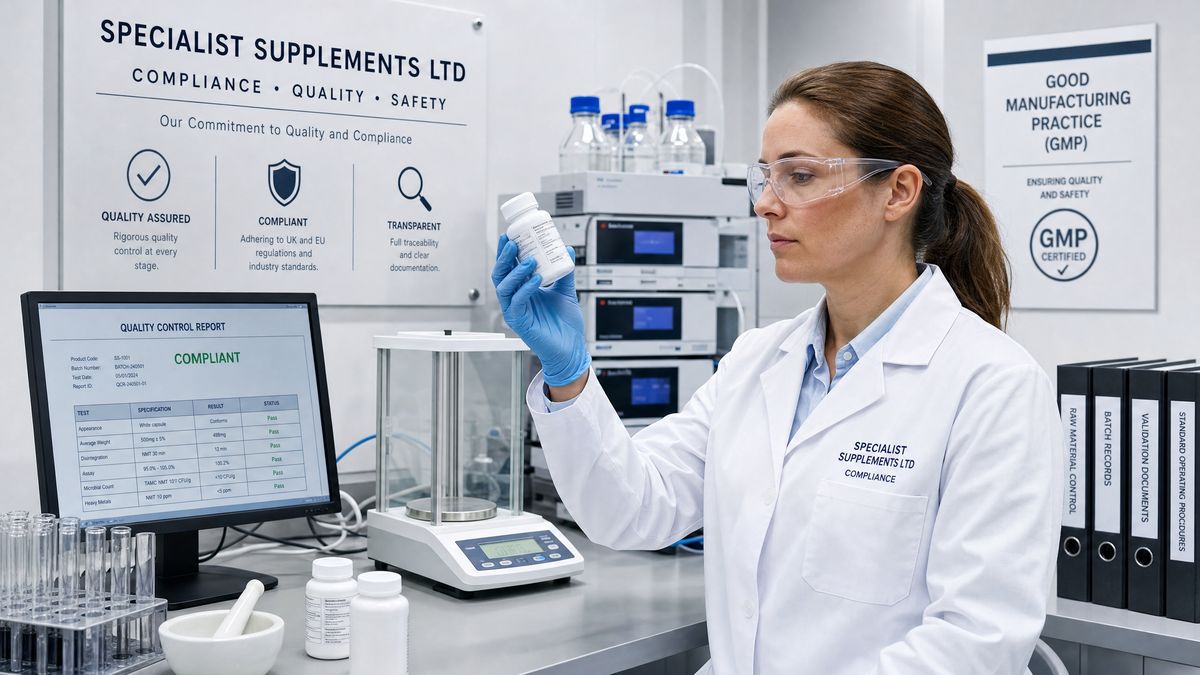
Ensuring the quality and safety of food supplements goes beyond basic legal compliance. Adhering to internationally recognised standards like Good Manufacturing Practice (GMP) and ISO 22000 demonstrates a commitment to excellence and consumer protection.
Good Manufacturing Practice (GMP)
Facility Cleanliness
Maintaining hygienic production environments.
Personnel Training
Ensuring staff are adequately trained for their roles.
Documentation
Comprehensive record-keeping for all processes.
Quality Control
Implementing robust checks throughout the manufacturing process.
Product Testing
Verifying the quality and purity of raw materials and finished products.
Compliance with GMP is crucial for building consumer confidence and is often a prerequisite for working with reputable retailers and distributors. Certification bodies like Intertek and Eurofins provide accredited GMP certification for dietary and food supplements [3, 4].
ISO 22000 Food Safety Management
ISO 22000 is an international standard that specifies requirements for a food safety management system (FSMS). It provides a framework for organisations to identify and control food safety hazards. ISO 22000 combines the core elements of ISO 9001 (Quality Management) and HACCP (Hazard Analysis and Critical Control Points) to create a comprehensive system [5].
Achieving ISO 22000 certification is particularly beneficial for businesses looking to sell through major retail channels, including online platforms like Amazon UK, and for those involved in international trade. It signals a high level of commitment to food safety and operational excellence [6].
Selling Online and Trade Protection
Selling vitamins and food supplements online in the UK presents unique opportunities but also requires careful consideration of compliance and business strategy.
Online Sales Considerations
While the internet offers a vast marketplace, businesses must ensure that their products and practices comply with all relevant regulations in the local markets where they sell, even if the sales are conducted remotely [7]. This includes adhering to UK-specific labelling, composition, and safety standards.
Trade Protection and Partnership Opportunities
For businesses operating in the wholesale and trade sector, protecting pricing information is vital. Specialist Supplements Ltd understands this need, which is why prices for trade customers are often hidden, requiring registration for a trade account. This approach ensures that trade partners receive exclusive access to pricing and other benefits, fostering strong business relationships.
Ready to grow your food supplement business with a trusted partner?
Register for a trade account today to access exclusive pricing and our full range of services.
Register for a Trade Account HereConclusion
Navigating the regulatory landscape for selling vitamins online in the UK can seem daunting, but with a clear understanding of the requirements and a commitment to best practices, businesses can thrive. From registering as an FBO and adhering to strict labelling laws to implementing robust quality assurance through GMP and ISO standards, every step contributes to consumer safety and business success. Specialist Supplements Ltd stands as a knowledgeable partner, leveraging experience since 1994 to support your journey in the dynamic food supplement market.
References
- [1] Food Standards Agency. (n.d.). Food supplements. Retrieved from https://www.food.gov.uk/business-guidance/food-supplements
- [2] Musheez.eu. (n.d.). UK food supplement notification procedure. Retrieved from https://musheez.eu/uk-food-supplement-notification-procedure/?srsltid=AfmBOor-422f3RE666GDzLH4IEt86uMA-9BMV9qjXKTnbd06mqN9QOLc
- [3] Intertek. (n.d.). Good Manufacturing Practice. Retrieved from https://www.intertek.com/auditing/gmp/
- [4] Eurofins. (n.d.). Accredited Dietary and Food supplements GMP Certification. Retrieved from https://www.eurofins.com/assurance/dietary-food-supplements-gmp-certification/
- [5] NQA. (n.d.). ISO 22000 Certification - Food Safety Management. Retrieved from https://www.nqa.com/en-gb/certification/standards/iso-22000
- [6] Vitamanufacture.co.uk. (2025, May 15). What Is ISO 22000 and Why It Matters for Retail and International Supplement Success. Retrieved from https://www.vitamanufacture.co.uk/post/what-is-iso-22000-and-why-it-matters-for-retail-and-international-supplement-success
- [7] Sidley. (2024, March 7). Points To Check When Selling Food Supplements Outside The U.S.. Retrieved from https://goodlifesci.sidley.com/2024/03/07/points-to-check-when-selling-food-supplements-outside-the-u-s/